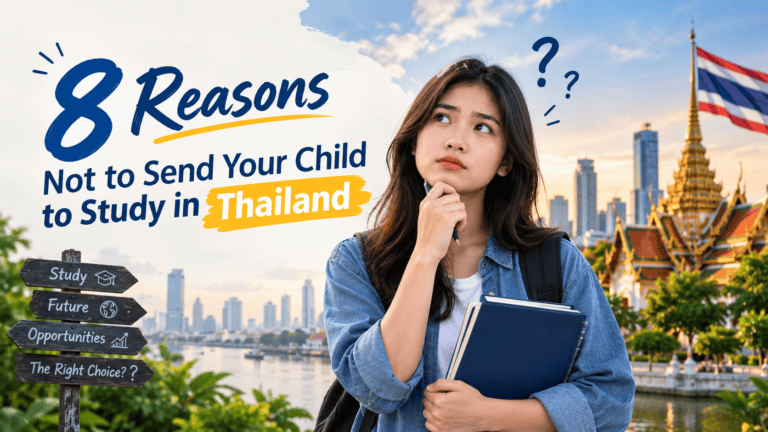


| Thailand has quietly become one of the most practical study abroad destinations for Nepali families who want genuine academic quality without the cost of a Western capital. With ten PEC-represented universities offering English-medium programmes, a transparent Non-Immigrant ED visa process through the Royal Thai Embassy in Kathmandu and a cost of living that makes parental visits realistic not aspirational. Here are eight reasons Nepali families are increasingly choosing Thailand over more obvious destinations. |
1. Your Child Might Get a Premium Education Without the Premium Price Tag
Private university programmes in Thailand for international students run roughly THB 120,000–400,000 per year, with specialised fields like medicine reaching THB 300,000–900,000. That’s a genuinely resourced, internationally benchmarked education at a fraction of equivalent tuition in the UK, USA or Australia which leaves more of the budget for the experience itself, not just the degree.
2. The Campus Experience Looks Nothing Like “Budget Study Abroad”
Students who want to live in serviced apartments and condominiums with international-standard amenities, with options from roughly THB 20,000/month upward in Bangkok. Rangsit University – one of Thailand’s largest private universities, with more than 20,000 students on its Pathum Thani campus and Bangkok University – one of the country’s oldest private universities, founded in 1962, with its own International College both offer the kind of resourced, established campus environment families look for once “budget” has been ruled out as the deciding factor.
3. Instruction Happens Entirely in English, at Genuinely Recognised Institutions
Assumption University of Thailand, founded in 1969, has used English as its official medium of instruction since it opened and is widely regarded as Thailand’s first international university. Dhurakij Pundit University, founded in 1968, runs its own International College (DPUIC), teaching entirely in English to students from more than 20 countries. For postgraduate study, the Asian Institute of Technology (AIT) an English-speaking, postgraduate-only institution founded in 1959 draws students from more than 50 countries into its engineering, environment and management programmes. None of these is a recently assembled “international track” bolted onto a local degree; each has decades of institutional history behind it.
4. Your Family Can Actually Visit Often
A short flight from Kathmandu means parents aren’t choosing between a term break visit and a plane ticket that costs more than the semester’s rent. Long weekends in Bangkok or Chiang Mai become genuinely realistic, not aspirational.
5. The Networking Is Regional, Not Just Local
A concentration of international institutions does real networking work on its own. AIT alone enrols students from more than 50 countries and Stamford International University, with campuses in Bangkok and Hua Hin, counts students from more than 100 countries among its community. For a family weighing where their child builds relationships that matter later – in finance, hospitality, healthcare or international business that’s a genuinely international, not just a local, student body.
6. The Visa Process Is Transparent, Not a Black Box
Families researching international education for the first time often worry most about the paperwork. Thailand keeps this predictable: a Non-Immigrant “ED” visa with a clear, published document checklist, applied for through the Royal Thai Embassy in Kathmandu. Students in bachelor’s-level programmes can move to an ED Plus visa afterward, allowing an extra year in-country to pursue work opportunities post-graduation.
7. The Lifestyle Is Genuinely World-Class
Thailand’s dining scene regularly ranks among the best globally, from Michelin-recognised restaurants to refined contemporary Thai cuisine. Add a safe, well-regulated environment and a culture that’s genuinely welcoming to international residents, and the “lifestyle trade-off” families often brace for with lower-cost destinations simply doesn’t apply here.
8. The Degree Travels Well
Thailand’s international education landscape isn’t one fixed model. AIT has built a regional research reputation in engineering, environment and management since 1959. The Asian Institute of Hospitality Management (AIHM), founded in 2020 by the Minor Hotels group in academic association with Switzerland’s Les Roches, places hospitality students inside an industry network of more than 35,000 professionals, with campuses in Bangkok and Pattaya. Dusit Thani College, established in 1993 under the Dusit International hospitality group, takes a similarly practice-based approach to hospitality and culinary education. At the Global Academy at Siam University, students can complete a dual-degree bachelor’s programme that ends with a second degree from La Trobe University (Australia) or the University of Victoria (Canada). A degree from Thailand isn’t a single path – it’s a set of established routes, each suited to a different goal.
FAQ: Premium International Education in Thailand
Is Thailand a good choice for families who want quality, not just low cost?
Yes, private and international university programmes offer internationally benchmarked curricula, English-medium instruction, and modern campus facilities, at costs still well below equivalent Western institutions.
What does premium student housing cost in Thailand?
Serviced apartments and international-standard condominiums in Bangkok start from roughly THB 20,000 per month, with a range of options above that for higher-end living.
Which universities in Thailand does PEC represent?
Rangsit University, Bangkok University, Asian Institute of Technology, Dhurakij Pundit University, Assumption University of Thailand, Global Siam University (Global Academy at Siam University), Stamford International University, the Asian Institute of Hospitality Management, Dusit Thani College, and Shinawatra University.
What visa is required, and is the process reliable?
Nepali students apply for a Non-Immigrant “ED” visa through the Royal Thai Embassy in Kathmandu, with a clearly defined document and financial checklist.
Does Thailand offer post-graduation work opportunities for international students?
Students in bachelor’s-level programmes or above can apply for an ED Plus visa, which allows an additional year in Thailand after graduation to pursue work opportunities.
So… Still Convinced Not to Consider Thailand?
If a well-resourced English-medium education, a genuinely international campus lifestyle, a transparent visa process, and a degree with regional career weight all sound like dealbreakers — fair enough.
For Students and families who want a considered second opinion, contact or visit Professional Education Consultancy where our certified and experienced counselors will walk you through which university and programme best fits your child’s goals.